
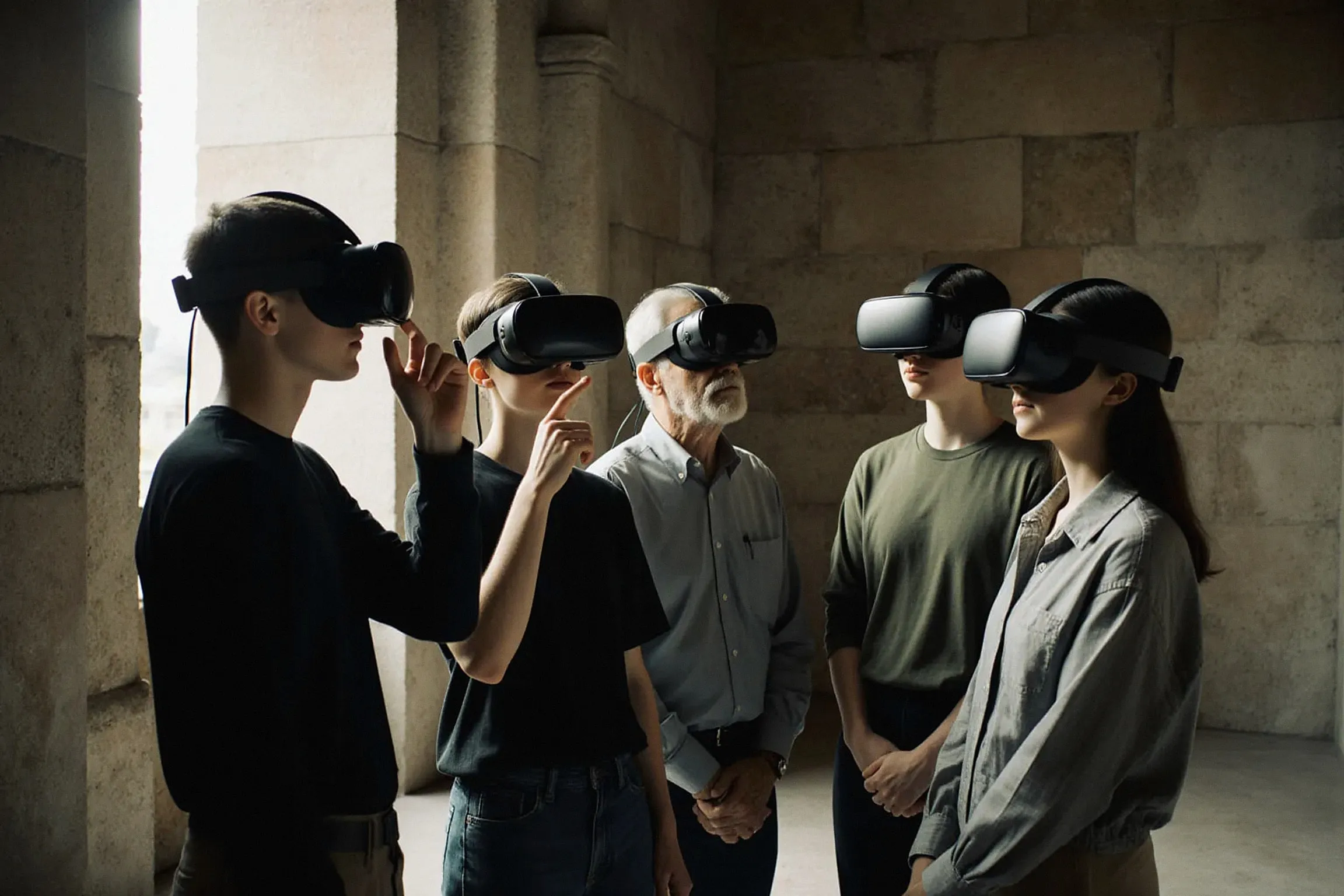






Your ideas belong in the room.
Bring the proof you cannot finish, the result that surprised you, the passage you disagree with. Your professor has time to follow your reasoning.
Concept image.
Three rooms.
A useful tutorial begins before the meeting. Each student prepares written work or a problem; the hour is spent on reasoning, objection and revision.
- 3–4
A tutorial
Time to explain, question and revise. The ordinary teaching faculty remain responsible for tutorials, laboratories, feedback and day-to-day capstone support.
- 8
A research seminar
Four one-hour seminars a year, with at most eight students, led by research professors who work directly with undergraduates.
- 250
A college
A lasting community and a named mentor across four years. Reading groups, visiting seminars and cultural life are optional; the timetable keeps them distinct from required work.
Forty hours. Two days at the center.
- With faculty
- Individual
- Collaboration
Scroll to walk through the day. Select any block for what happens in it.
Placement within a day is illustrative; the hour totals are the proposal's. Advising is thirty minutes every two weeks, so this week shows it in full and the totals its average. Travel is additional.
A tutor that can show its work.
It can see your attempted reasoning, retrieve the relevant source and call a checked calculation, without confusing those different kinds of evidence.
An illustration of a tutoring exchange, built on the proposal's own reference case. Private study stays separate from formal assessment, and the tutor never replaces an academic supervisor.
At d = 4, why does my controller fail to reach a = 1?
Find the largest cooling effect allowed by 0 ≤ u ≤ 1. What equilibrium follows from that limit?
Choose a move. The source or the checked calculation appears here, marked as what it is.
Show me the source.
Retrieved, not recalled.
The control u is bounded, 0 ≤ u ≤ 1. The equilibrium of a = d − 2u therefore lies in the interval [d − 2, d]. A target outside it is not a tuning problem; it is infeasible.
With d = 4 the interval is [2, 4]. Where is your target a = 1?
Run the calculation.
Calling the checked model with d = 4 and u at its upper bound.
The smallest reachable a is 2. The controller is not failing; the target is outside what the bound allows.
Just a hint.
Try u = 1 by hand. What is the smallest a you can reach with d = 4? Then compare it with your target.
a = 4 − 2 = 2. So a = 1 was never reachable.
Yes. Now say why in one sentence; that sentence is what you bring to the tutorial.